General George C. Marshall
Special to the Newsletter by Michael F. Bishop
George Marshall was one of the most influential American soldiers and statesmen of the twentieth century, a figure whose quiet competence helped achieve Allied victory in World War II and the reconstruction of a shattered Europe. Known for his integrity, organizational genius, and aversion to self-promotion, he earned the respect of presidents, foreign leaders, and subordinates. Although he never commanded armies in the field, his impact on strategy, logistics, and diplomacy was greater than that of many who did.
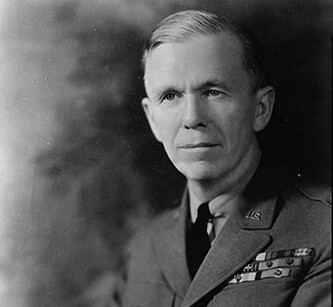
George Catlett Marshall was born on December 31, 1880, in Uniontown, Pennsylvania. Raised in a middle-class family, he was not initially destined for prominence. His early academic record was modest, and he failed to gain entrance to West Point, and attended the Virginia Military Institute, (VMI), instead. There, he displayed innate military discipline and leadership and graduated in 1901. Marshall’s early army career took him to postings in the Philippines, on the Mexican border, and in various training and staff roles. These early experiences honed his skills in tactics, logistics, handling complex organizations, and dealing with diverse personalities–preparation that would prove crucial during the global conflicts to come.
Marshall first came to wider attention during World War I, serving as a staff officer in France. He worked closely with General John J. Pershing and played a critical role in planning the Meuse-Argonne Offensive, one of the largest operations involving American forces. Though he did not gain the public notoriety of frontline commanders, his superiors recognized his remarkable organizational talent and calm under pressure. After the war, Marshall continued to serve in various staff and training positions, including a significant role at the Infantry School at Fort Benning, in Georgia, where he helped modernize doctrine and mentored a generation of younger officers. Some of these protégés, such as Omar Bradley and Dwight D. Eisenhower, would later become key leaders in World War II, enhancing Marshall’s influence.
In 1939, on the eve of the Second World War, President Franklin D. Roosevelt appointed Marshall as Army Chief of Staff. At the time, the U.S. Army was small, underfunded, and ill-prepared for a major conflict, but Marshall faced the monumental task of transforming a peacetime force into a vast, modern army capable of global warfare. Through relentless effort and often blunt counsel to political leaders, he oversaw the rapid expansion and reorganization of the U.S. Army from fewer than 200,000 soldiers to millions of trained troops. Marshall helped shape grand strategy, advocating the “Germany first” approach and supporting large-scale operations in North Africa, Italy, and—ultimately– Normandy. He also showed rare restraint and professionalism by not pressing for a field command in Europe, despite his earnest desire to lead the Allied invasion.
Marshall’s relationship with other Allied leaders further highlighted his diplomatic skill. He worked closely with Roosevelt, Winston Churchill, and later with General Eisenhower, forming a crucial link among the political and military leadership of the Allied coalition. Even when he disagreed with Churchill’s preference for peripheral Mediterranean campaigns, he maintained a constructive working relationship, pushing persistently, yet tactfully, for a cross-Channel invasion. His combination of firmness and discretion helped avoid damaging rifts within the alliance. At home, Marshall was widely trusted by Congress and the public, partly because he appeared above partisan politics and partly because of his reputation for honesty and efficiency.
After World War II, Marshall briefly retired, but President Harry S. Truman soon called him back to service as special envoy to China in 1945–46. Truman hoped that Marshall’s prestige might help broker peace between the Chinese Nationalists and Communists. Despite months of arduous negotiation, the mission failed, largely because of the underlying political and military realities in China could not be reconciled through mediation alone. Nonetheless, the effort underscored Marshall’s willingness to take on difficult assignments, and his growing role as an architect of postwar policy. His most enduring contribution, however, came after his appointment as Secretary of State in 1947.
As Secretary of State, Marshall lent his name and leadership to the European Recovery Program, better known as the Marshall Plan. Announced in his Harvard commencement speech in June 1947, the plan proposed massive U.S. economic assistance to help rebuild war-ravaged European economies, stabilize democratic governments, and prevent the spread of communism. It was revolutionary not just in scale, but in spirit: rather than punishing defeated enemies, it aimed to restore prosperity across Western Europe—including–Germany. Under Marshall’s direction, the plan provided billions of dollars in aid, fostered cooperation among European nations, and laid the groundwork for deeper integration that would eventually lead to the European Union. The program’s success helped secure Western Europe’s recovery, firmly aligned it with the United States, and reshaped the strategic balance of the early Cold War.
Marshall’s public service did not end there. In 1950, during the Korean War, Truman appointed him Secretary of Defense. Despite his yearning for retirement, Marshall undertook the task of reorganizing the military establishment for a new kind of limited war. He supported Truman’s controversial firing of General Douglas MacArthur after he challenged civilian control of the military, but the move reinforced a vital constitutional principle.
In recognition of his contributions to peace and reconstruction, George Marshall received the Nobel Peace Prize in 1953, a rare honor for a career soldier. The award underscored the dual nature of his legacy: he was a master of war and a builder of peace. Unlike many prominent figures, Marshall left no memoirs to shape his public image; he preferred to let his record speak for itself. He died on October 16, 1959, in Washington, D.C., leaving behind an enduring example of integrity, competence, and selfless public service. He is remembered for the immense logistical feat of mobilizing a nation for global war, and the vision and generosity that helped transform enemies into partners and laid the foundation for a more stable international order.
Michael F. Bishop, a writer and historian, is the former executive director of the International Churchill Society and the Abraham Lincoln Bicentennial Commission.