Becoming Roy Lichtenstein:
The Path to Pop
by Avis Berman
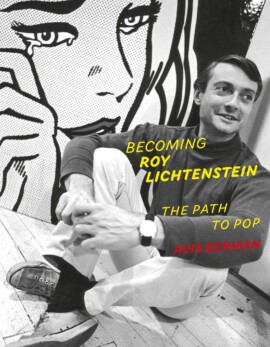
Becoming Roy Lichtenstein: The Path to Pop by Avis Berman. Abbeville Press, 2026.
Reviewed by Ed Lengel
When did comic art become pop art? For that matter, when did comic art become art? The answers to both questions beget stories, and they are all good ones. Comic art originates in the late nineteenth century with the rise of popular newspapers. Initially satirical, dense, and esoteric by modern standards, comics—the “funnies”—became increasingly mainstream in the beginning of the twentieth century, and then leapt from newspapers to films and then, in the 1920s and 1930s, to pulp magazines and comic books. By the post-World War II era, popular illustration had become an industry, employing thousands of men and women in print and film animation.
It was from this tradition of comic art that the greatest late-twentieth-century pop artists, Roy Lichtenstein among them, drew inspiration. There was another tradition, also called popular art, that became a staple of middle-class and highbrow magazines and advertising—namely, works of artists such as Charles Dana Gibson, J.C. Leyendecker, and Norman Rockwell—but Lichtenstein and his ilk sidestepped it, instead discovering meaning in a comic art medium that most others derided as throwaway, at best.
Becoming Roy Lichtenstein builds outward from an iconic moment in June 1961 when the artist, then still an obscure art professor toiling in the obscurities and abstractions of modernistic studio art, picked up a Little Golden Book his children had been reading, Walt Disney’s Donald Duck, Lost and Found, and discovered a slapstick image of Donald Duck and Mickey Mouse fishing. From it he adapted his own piece, Look Mickey, which was destined to establish his own career and transform the art world. From this moment, author Avis Berman proceeds to present a thorough, straightforward, and illuminating biography of Roy Lichtenstein, beginning with his German-Jewish ancestry and childhood in New York City in the booming 1920s, through his long, often frustrating career in academe and art, to his first moment in the spotlight after 1961, setting him on the path to fame as an iconic pop artist fit to stand alongside the likes of Andy Warhol.
Far from being offkey or rebellious, the young Roy Lichtenstein seemed a generic product of a staid, privileged Manhattan upbringing. To his parents Roy seemed, in fact, rather mediocre; especially given his penchant for perusing comic strips like Buck Rogers and Flash Gordon. That he would waste time on such drivel—also becoming an avid devotee of jazz music—instead of focusing on academics or business seemed to confirm his lack of promise.
Lichtenstein’s beginnings as an education and then an art student at Ohio State University seemed a harbinger of more mediocrity until, ironically, military service in the U.S. Army in Europe during World War II provided negative artistic inspiration; his first paintings after returning stateside and resuming studies were dedicated to the folly of war, and he would later draw on war-themed comic books for anti-military inspiration at the height of his career. Still, Lichtenstein’s artistic efforts from his academic postings in the 1950s seem derivative of early twentieth-century modernism and, had he not progressed further, his career would indeed have been eminently forgettable.
In the late 1950s, finally, Lichtenstein, while remaining firmly embedded both in academic and high art culture, began observing and then experimenting with comic art then being mass-produced on film and in print by studios such as Disney and Warner Brothers—perhaps because, then with young children of his own, he was constantly exposed to it. Avis Berman spends the final two chapters of her book analyzing, first, Lichtenstein’s decision to explore this new frontier in his own art; and second, exploring the creation of Look Mickey and other comic-based pieces in 1961 to their first gallery displays, which is where Becoming Roy Lichtenstein concludes.
As a biography, Becoming Roy Lichtenstein is thoroughly researched and presented, and well-written. Berman has researched her subject’s life carefully, including through extensive interviews with family members and friends, and meticulously examines Lichtenstein’s artistic productions up to 1961 and in some cases, beyond. Crucially, she situates his intellectual, personal, and artistic development in the context of the progress of American popular culture, especially during his youth in the 1920s-1930s.
For all this effort, however, Berman does not really answer a question that, in fairness, may well be unanswerable; that is, why did Lichtenstein, after many years of producing pedestrian high art, more or less suddenly turn to comic art for inspiration? Lichtenstein was often asked this question in his lifetime, and never fully answered it, perhaps because he didn’t know himself. Yet a second and perhaps more important question is why this artistic turn resonated simultaneously in the world of fashionable New York City galleries and, subsequently, with the American public? Is it, perhaps, that comic art always possessed greater artistic merit than it was given credit for; that drawing on the comics made studio art more accessible; that haute artistes brought comic art up to a new level that it had been unable to attain on its own; or some combination of all of the above? In this respect at least, the gorgeously illustrated and intriguing Becoming Roy Lichtenstein invites a sequel.
Ed Lengel is an author, a speaker, and a storyteller.