Barbara Kingsolver
Special to the Newsletter by Michael F. Bishop
Barbara Kingsolver is an American novelist, essayist, and poet whose work blends literary craft with attention to environmental concerns, family dynamics, and the lives of people in rural or marginalized communities.
She was born on April 8, 1955, in Annapolis, Maryland, and was raised primarily in rural eastern Kentucky, where her father worked as a physician treating the rural poor. As a child, the family spent time in Léopoldville (now Kinshasa) in Congo, an experience that later informed her novel The Poisonwood Bible. Kingsolver attended DePauw University in Indiana on a music scholarship as a classical pianist, but switched to biology, graduating Phi Beta Kappa in 1977. She later earned a master’s degree in, ecology and evolutionary biology from the University of Arizona.
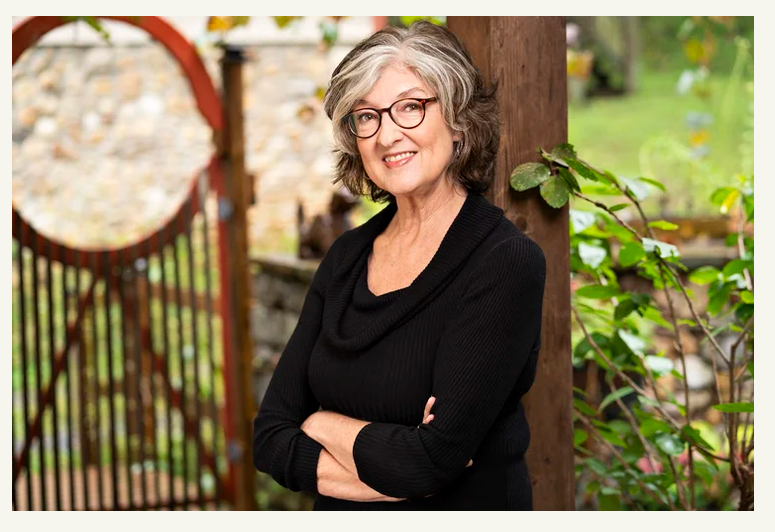
Photo by Evan Kafka
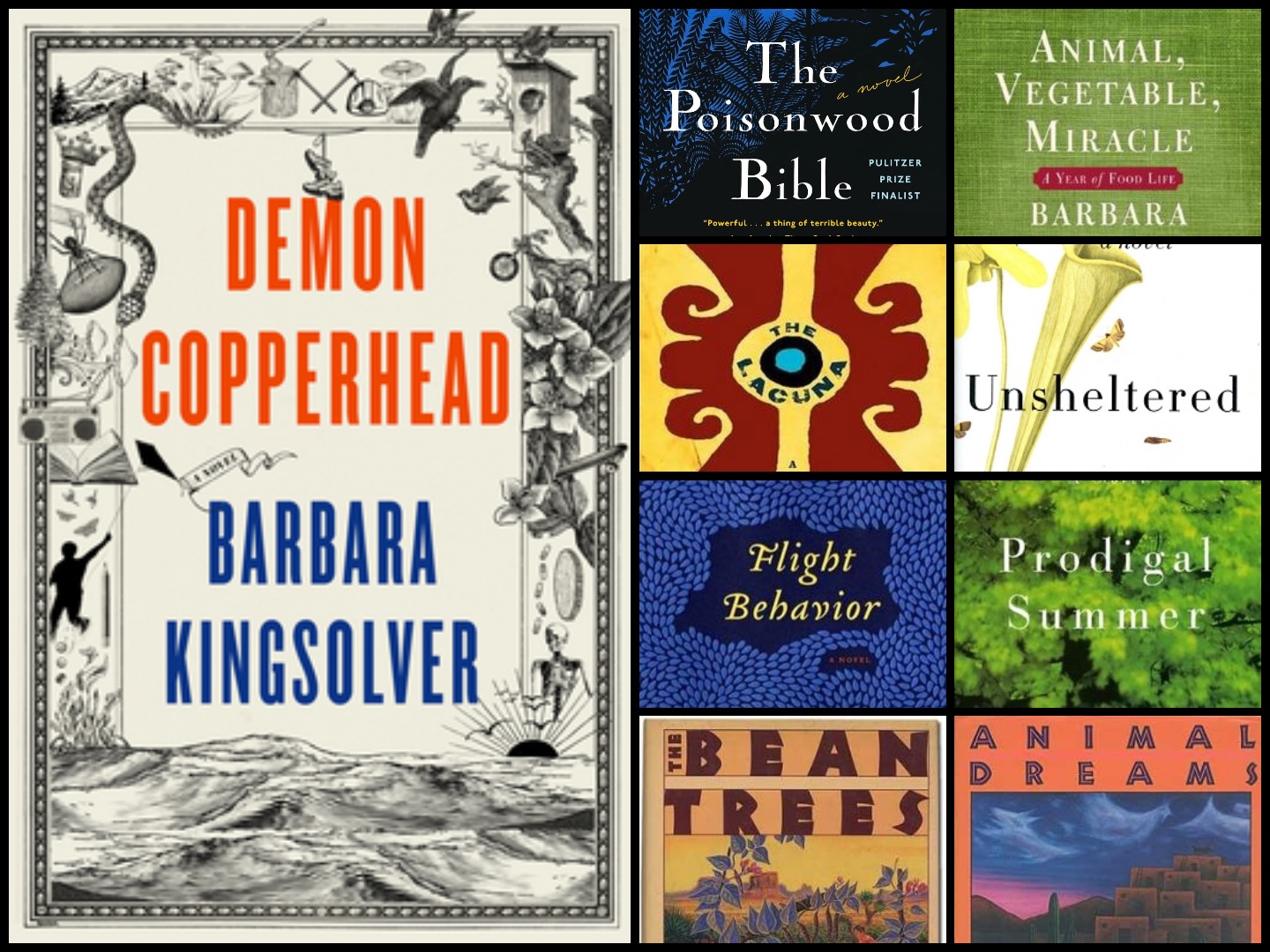
After graduate school she worked as a science writer, freelance journalist, and in various other jobs while living in Tucson, Arizona. She began writing fiction in earnest in the 1980s. Her debut novel, The Bean Trees, followed a young woman from Kentucky who settles in the Southwest and forms an unexpected family with a young Cherokee girl. It was succeeded by the short story collection Homeland and Other Stories, Animal Dreams, and Pigs in Heaven, a sequel of sorts to her first novel that explores adoption, Native American rights, and belonging. These early books established her as a distinctive voice writing about women, place, and moral choice.
Her breakthrough came in 1988 with The Poisonwood Bible, an epic told through the voices of a missionary’s wife and four daughters as they confront the Congo in the late 1950s and early 1960s. The novel examined colonialism, faith, family, and the collision of cultures; it sold millions of copies, was selected for Oprah’s Book Club, and was a Pulitzer Prize finalist. Subsequent works continued to range widely: Prodigal Summer intertwined stories about ecology and human connection in Appalachia; The Lacuna, which mixed history and fiction around Frida Kahlo, Diego Rivera, Leon Trotsky, and the McCarthy era, won the Orange Prize (now the Women’s Prize for Fiction); Flight Behavior explored climate change and rural life through the story of monarch butterflies; and Unsheltered paired contemporary economic anxiety with 19th-century intellectual ferment.
In 2022 she published Demon Copperhead, a modern retelling of Charles Dickens’s David Copperfield set in southern Appalachia and centered on a boy navigating poverty, foster care, and the opioid crisis. Narrated in a vivid, first-person voice, the novel was a commercial and critical triumph. It won the 2023 Pulitzer Prize for Fiction and the Women’s Prize for Fiction, -and was widely praised for its sympathetic portrait of a region often stereotyped or ignored.
Her most recent novel, Partita, is a more intimate work structured around musical forms. It follows Livia Cable, a middle-aged piano teacher in rural Tennessee whose quiet life is disrupted by a call from a former lover, prompting dual timelines that explore ambition, loss, class, family trauma, and the sustaining power of art and music.
Across fiction and nonfiction, Kingsolver’s recurring subjects include biodiversity and human relationships with the land (informed by her scientific training), feminism, immigration and cultural encounter, economic inequality, and the dignity of ordinary people. Her 2007 nonfiction book Animal, Vegetable, Miracle (written with her husband and daughter) chronicles a year of eating locally on their farm. She has also published essay collections such as High Tide in Tucson and Small Wonder, poetry (Another America, How to Fly), and a children’s book.
A longtime advocate for literature that engages social issues, she founded the Bellwether Prize (now associated with the PEN/Bellwether Prize) to support fiction that addresses what she considers positive social change.
She has received the National Humanities Medal (presented by President Bill Clinton in 2000), the Dayton Literary Peace Prize for her body of work, and the National Book Foundation’s Medal for Distinguished Contribution to American Letters. Her books have been translated into more than thirty languages and are widely taught.
Kingsolver lives with her husband, Steven Hopp (an environmental educator), on a farm in southwestern Virginia, where they raise vegetables, chickens, and Icelandic sheep.
Michael F. Bishop, a writer and historian, is the former executive director of the International Churchill Society and the Abraham Lincoln Bicentennial Commission.