Coal Miner’s Daughter
by Loretta Lynn
Reviewed by Ed Lengel
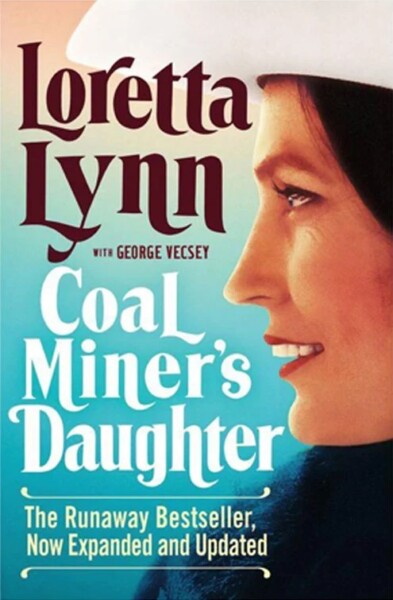
Coal Miner’s Daughter, by Loretta Lynn (originally published 1976; new edition, 2021)
Few American subcultures have been subjected to stereotype—mostly pejorative—as much as rural Appalachia. Peopled by the descendants of eighteenth and nineteenth century Scots Irish settlers, intermixed to varying degrees with Native Americans, these regions remained deeply isolated, and impoverished, well into the twentieth century. The coal industry’s development proved a mixed blessing for the people of this region, offering them desperately needed employment, but at the cost of poor pay, dismal working and living conditions, and diseases including the dreaded “black lung” induced by coal dust. The coal industry’s collapse in the mid-to-late twentieth century would devastate rural Appalachia’s economy, leaving people—in many respects—worse off than they had ever been before.
To outsiders, though, people living in rural Appalachia from Pennsylvania to the Carolinas were—and to some degree still are—mocked as “hillbillies,” quaint at best and filthy, even subhuman, at worst. Cultural references are endless, ranging from the goofy stereotypes of the 1960s TV series Beverly Hillbillies to the more menacing, even monstrous characters of James Dickey’s novel Deliverance, made into a famous movie in 1972. In music, Bluegrass artists like Bill Monroe and his followers now have presented, alternately, authentic testimonies of Appalachian life in all its beauties and hardships, and sanitized visions of men in Stetson hats and country suits.
Loretta Lynn, now regarded mainly as a country music artist, but with influences in many genres including Bluegrass, was a pioneer in terms of her tremendous talent, and her ability to capture the realities of Appalachian life, from its grimmest lows, to its sometimes sordid but always solidly real every day, and finally to the often-sublime richness of its culture. Born Loretta Webb in 1932 in Butcher Hollow in Johnson County in eastern Kentucky, immortalized by the opening line, “I was born’d a coal-miner’s daughter, in a cabin on a hill in Butcher Holler,” from her career-defining 1970 song “Coal Miner’s Daughter,” she grew up in a large, deeply impoverished family (including sister and future music star Crystal Gayle) that was torn apart by her father’s death from the effects of black lung in 1959.
Like many girls of her background, Lynn married as a teenager—in her case at fifteen—to Oliver “Doo” Lynn, Jr., and immediately began bearing children. By the time she began her singing career in the late 1950s, she and her husband had relocated to rural Washington State, and Lynn had already given birth to four of her eventual six children. Still, living on the west coast proved a boon for her career in the 1950s and early 1960s, giving her a head start on other would-be country artists still struggling in the relatively isolated towns in the Appalachian Mountains or the Deep South. Unlike many of them, Lynn got recording opportunities in Hollywood studios relatively early in her career, and made friends with fellow female music pioneers like Patsy Cline and Tammy Wynette that also boosted her profile.
Still, it was only in the mid-to-late 1960s, when Lynn turned to performing songs grounded in her Kentucky youth, and in her lifelong but rollickingly tempestuous marriage to her alcoholic husband, that Lynn’s career took off—partly because she was able to touch a chord with much of the American public. This was also when Appalachian poverty was brought into public focus for the first time in the context of President Lyndon B. Johnson’s Great Society programs. Lynn’s songs during this period, including “You Ain’t Woman Enough (To Take My Man)” (1966), “Don’t Come Home A-Drinkin (With Lovin’ On Your Mind)” (1967), “Fist City” (1968), “Woman of the World (Leave My World Alone)” (1969), and finally her beloved “Coal Miner’s Daughter” (1970), turned her into a country superstar.
By the time she wrote her autobiography, Coal Miner’s Daughter in 1976—a book that immediately shot to the top of the New York Times Best Seller list and remained there for eight weeks—Loretta Lynn was at the peak of her career. The release in 1980 of an Academy Award-winning biopic of the same title, starring Sissy Spacek and Tommy Lee Jones, confirmed Lynn’s status as the prototypical poor girl who had made it big. Alongside fellow star Dolly Parton, who had grown up under similar circumstances in Appalachian Tennessee, Lynn sought to use her celebrity in part to bring attention to—and help uplift—the people among whom she had grown up. Lynn opened a museum named after her biography, featuring a replica homestead built for the movie, in Hurricane Mills, Tennessee.
Fortunately for posterity, Lynn revised her biography to coincide with the movie’s fortieth anniversary and released an updated edition in 2021 just before she turned eighty-nine years old (she died the following year). Coal Miner’s Daughter is in some respects the stereotypical rags-to-riches story, and very much one with a happy ending despite continuing challenges and heartbreak within her own family; but the narrative is deeply sympathetic and engaging. With Dolly Parton’s death in 2026, it’s worth revisiting Coal Miner’s Daughter to understand the world from which these two outstanding women arose, and to pay tribute to their ongoing transformation of American culture through music grounded in their roots.
Ed Lengel is an author, a speaker, and a storyteller.