Frank Capra: A Life
by Sam Wasson
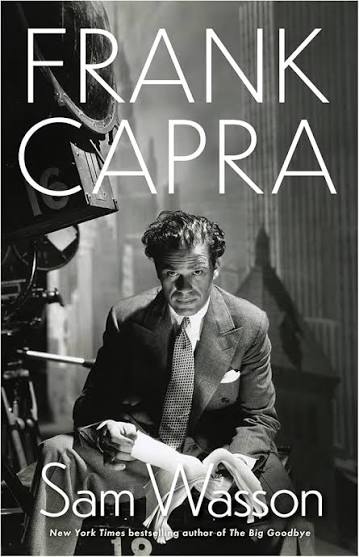
Frank Capra: A Life, by Sam Wasson. Harper, 2026.
Reviewed by Ed Lengel
Frank Capra’s life is the quintessential American story. Perhaps it’s small wonder, then, that he became the foremost chronicler—inventor, even—of the American story as told by Hollywood. As author Sam Wasson puts it in his new biography, Frank Capra: A Life, Capra’s “films set the template for what we think of as the Hollywood movie: the everyday David trouncing the corporate Goliath, the power of one to change the lives of many, the triumph of love and justice and hope over tyranny, the all-in joy of shared laughter, the spiritual necessity of struggle and lonely conviction.”
This great American film director was born in Sicily in 1897, under the name Francesco Rosario Capra. He was the youngest of seven children in an impoverished family that could only afford the cheapest steerage berth on the steamship that brought them to America—part of the great wave of immigration—in 1903. The crossing’s squalor remained fixed in Capra’s mind for the rest of his life; but he also never forgot his father’s exultant reaction to seeing the Statue of Liberty in New York Harbor, when he exclaimed: “Look at that! That’s the greatest light since the Star of Bethlehem! That’s the light of freedom. Remember that. Freedom.”
After passing through Ellis Island, Capra and his family immediately crossed the entire continental United States to the west coast, where he had an uncle living in Los Angeles. Spending his youth in a poor neighborhood on the city’s East Side, where his father worked as a fruit picker, Capra helped his family make ends meet by working odd jobs while attending school. The turning point for him was the decision to attend college at the California Institute of Technology instead of going straight to full-time work as his father desired. Capra nevertheless had to work to pay his way through school, but he flourished in college, viewing education as a privilege to be embraced gratefully rather than a right, or rite of passage. After his 1918 graduation, Capra was commissioned a lieutenant in the U.S. Army before influenza truncated his service.
Unfortunately, Capra’s college degree provided no ticket to prosperity. After he became an American citizen in 1920, Capra discovered that his swarthy, obviously Italian looks and background kept him on the edge of society; for several years he dipped in and out of poverty as he worked menial jobs to survive, leading him to fear that he had failed his family. His fascination with movies, enabled him to secure parts as a film extra and opportunities to experiment with filming his own low- to no-budget documentary movies, put him on a very slow road to salvation. Working tenuous connections and recommendations, he finally got to do gig work with directors such as Hal Roach, Mack Sennett, and comedy star Harry Langdon.
By the late 1920s, finally, Capra joined the newly formed Columbia Pictures, where thanks to his easy adaptation to the new sound technology, he began directing numerous short pictures. His breakthrough came in 1934 with It Happened One Night, a smashing success that turned Clark Gable and Claudette Colbert into stars and earned Capra the first of three Academy Awards as best director. This success gave Capra the freedom to choose his own direction for the future; he decided to move away from the comedic themes that had defined his career thus far, to create movies with meaning.
One hit followed another as Capra won two more Academy Awards for Mr. Deeds Goes to Town (1936) and You Can’t Take It with You (1938). His two most memorable films today, for which he received Best Director nominations but not awards, were Mr. Smith Goes to Washington (1939) and It’s a Wonderful Life (1946). The latter film followed several years of work producing the Why We Fight series to inspire troops and other Americans with his own deeply felt sense of patriotism.
As Wasson argues, Capra wasn’t so much a creature of Hollywood as he was a sculptor of a particular vision of what Hollywood, and movies, were all about. “Erroneously thought to be native to Hollywood,” Wasson writes, the moralistic, patriotic elements of a typical Capra film “were actually brought together there and perfected by Frank Capra, whose name and work are synonymous with the American dream when it was not just a dream.” Actors who rose to stardom through Capra movies, such as Clark Gable, Gary Cooper, and Jimmy Stewart, seemed to embody these concepts. The sole tragedy of Capra’s career is that he lived long enough to become disenchanted with Hollywood as it embraced a far more cynical American cultural ethos from the 1960s onward.
Wasson’s biography of Capra is adulatory but idiosyncratic. Its’ narrative style echoes the snappy, novelistic, sometimes brusque and bombastic attributes that have long typified the entertainment biography genre. Capra’s life is presented episodically under the recurring headings of “Himself,” “His Hollywood,” and “His Depression,” with intermittent thematic quotes. This approach is as novel as it is often disorienting and unfortunately draws attention to Wasson’s literary prestidigitation when it should properly remain with the subject, Frank Capra. That said, Frank Capra: A Life remains a worthy tribute to a man who in many ways defined the American movie.
Ed Lengel is an author, a speaker, and a storyteller.