A Good Man is Hard to Find
by Flannery O'Connor
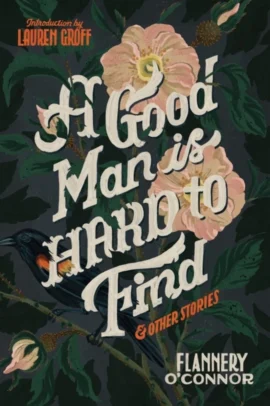
A Good Man is Hard to Find & Other Stories, by Flannery O’Connor.
Originally published 1955.
Reviewed by Ed Lengel
Flannery O’Connor (1925-1964) is among one of America’s most challenging writers. Not because of any difficulty in her writing style, which flows evocatively, with easy brilliance—but through the raw intensity of the characters and situations in her stories. Sensitive readers who seek to maintain some emotional distance from the written page will find it exceptionally hard to stay aloof from O’Connor’s writing: she’ll pull you right in and give you an emotional and moral beating. No one can escape from that experience.
O’Connor’s impressive handful of novels and stories exist within multiple types of writing, and that in itself is unique. She stands among the foremost of twentieth-century English-language Catholic writers, her devoutness equal to the most fervent of them, but the savagery of her wit met only, and very differently, by British authors such as Evelyn Waugh, Anthony Burgess, or Graham Greene. At the same time, O’Connor is the most Southern of American writers. Her stories are set exclusively in the Deep South; her characters are almost all products of that region—in many cases, squelching, mud and sin-stained, direct from the fetid bayous.
As that imagery suggests, O’Connor is unique, simultaneously a complete insider and outsider from the Catholic and Southern literary genres. As a Catholic, O’Connor engages directly, even elementally, with concepts such as evil, corruption, and original sin in ways that no other Catholic writer even came close to matching. Themes of grace and forgiveness are there too, but—designedly by the author—quite challenging to unearth and disentangle. Likewise, as a Southern writer, O’Connor bears some similarity to William Faulkner and Tennessee Williams (who highly praised her work) in darkness, and she has been called a pioneer of the Southern Gothic style. Yet she also exceeds any of her Southern peers in her willingness, even zest, for exposing the most hideous elements of Southern culture and life—making racism seem like a minor smudge floating within a constellation of more outstanding horrors.
A Good Man is Hard to Find is a collection of nine short stories and one novelette. Each one packs a punch. The first story, which lends to the collection its title, depicts a grandmother’s selfishness and dishonesty inadvertently leading an entire family to death at the hands of a serial killer and his cronies. The second story, The River, presents characters embodying the twin evils of religious hypocrisy and urban dissipation, leading to the death of an innocent. Other tales carry on in the same way with a traveling salesman victimizing a handicapped child and her grandmother; shallow Catholic school girls in search of sexual liberation more likely leading to perdition; a racist grandfather taking a boy to the city to ridicule African Americans, and betraying the child there; three evil boys plaguing a complacent widow; an elderly Civil War veteran who is manipulated by his family for their own ends, and more of the like.
An unsophisticated reading of these stories stops with their brutality. Almost without exception, O’Connor depicts human beings as inherently ugly inside, and out; in contrast with animals and nature, which she describes tenderly. As if mesmerized, many readers proved unable to penetrate these shocking images and contrasts. O’Connor declared herself “tired of reading reviews that call A Good Man brutal and sarcastic. The stories are hard, but they are hard because there is nothing harder or less sentimental than Christian realism. When I see these stories described as horror stories . . . the reviewer always has hold of the wrong horror.”
The true horror, in O’Connor’s mind, was what she believed to be the truth of the Catholic doctrine of human depravity and original sin. People, in her view, possess no merit in themselves; rather, they are corrupt since Adam’s sin in the Garden of Eden. Without grace—which O’Connor clearly believed that the evangelical Christianity of the South could not hope to provide—humans became slaves of sin, and evil. While possessing some degree of innocence, even the children who frequently appear in her stories are not immune from these truths. Yet each, she also believed, received opportunities to seek and receive grace and forgiveness, without which their salvation was impossible. A few, O’Conner believed, accepted this narrow path to salvation, but many, perhaps most, did not, wherein lay tragedy.
Ultimately, O’Conner’s Catholicism cast every other element of her identity, including her Southern culture, into the shade. A genetic victim of the autoimmune disease lupus, which claimed her father—and—later—her—at the age of thirty-nine. She suspected it would. The relentless originality of her approach to these issues is among the things that make her writing so unique and compelling. Only the final story in the collection, The Displaced Person, breaks from this trend by becoming at times conventionally, even tiresomely theological. As such, though, it is the exception that proves the rule of Flannery O’Connor’s work being among the most outstanding in twentieth-century American literature.
Ed Lengel is an author, a speaker, and a storyteller.