The Heart Is a Lonely Hunter
by Carson McCullers
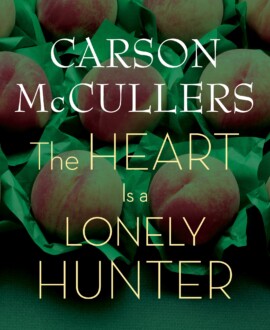
The Heart Is a Lonely Hunter, by Carson McCullers. Originally published 1940.
Reviewed by Ed Lengel
Carson McCullers is among the most individualistic writers in Southern fiction. Her first novel, The Heart Is a Lonely Hunter, published in 1940 when she was twenty-three, is one of the most unique American novels. Set in a small Georgia town during the Great Depression, it introduces an unexpected cast of characters whose interactions, and inner desperation, mirror McCullers’s struggles; millions of other Americans, and offers a rare, empathic insights to marginalized populations, not least among them Southern Blacks.
Born Lula Carson Smith in Columbus, Georgia, in 1917 to a middle-class family (her father was a jeweler), she demonstrated an early aptitude for creativity, particularly music. She studied piano until a severe bout of rheumatic fever affected her ability to use her hands and forced her to abandon her childhood dream of becoming a musician. Instead, she refocused her efforts on reading and writing, aspiring to make her mark in literature with the wholehearted support of her mother, who recognized her daughter’s exceptional talent. Her husband, James McCullers, Jr., whom she married at the age of twenty in 1937, thenceforward taking the name Carson McCullers. The marriage was troubled, and the publication of her first novel three years later tore the marriage apart.
The Heart Is a Lonely Hunter features several characters whose personal stories move at specific tangents, intersecting occasionally, but significantly. The story follows no specific plot, being framed loosely around the story of two deaf-mutes, John Singer and Spiros Antonapoulus, who enjoy an extremely close friendship, until Spiros is committed to an asylum, leaving Singer to navigate a lonely world alone. Singer then becomes a kind of silent confessor, sage, or at least sounding board for other characters struggling to find purpose in life, such as worker Jake Blount, restaurant-owner Biff Brannon, Black physician Benedict Copeland and his family, and especially twelve-year-old Margaret “Mick” Kelly, a restless girl whose mental and physical wanderings clearly reflect McCullers’ difficulties.
Singer has a wisdom that neither enunciates nor prescribes. His primary capacity is silent attention and empathy, making him almost a kind of abstract Godlike figure. His interlocutors, such as the alcoholic Blount, perform and rage in Singer’s steady, wordless presence, and then when their darker impulses are expressed, finds peace and purpose of their own volition. Singer, ironically, yearns most to reach his friend Spiros, but the latter retreats progressively into imbecility and self-indulgence. Singer provides succor to Blount, Brannon, Mick, and the others not out of any specific love or desire to provide aid, but almost as if compassion is an attribute he cannot resist sharing.
Notably, the characters’ various struggles are, at their root, not emotional, spiritual, physical, or economic, but intellectual. McCullers was–in this respect–an outsider to the Southern society into which she was born. In the late 1930s she went to study creative writing at Columbia University, and in the 1940s she relocated to New York City, and became absorbed in the society of northeastern literary intellectuals. In The Heart Is a Lonely Hunter and–more in her subsequent works–McCullers’s characters are Southern by circumstance, but their preoccupations—with Marxism, social structures, sexual identities, mark them as intellectuals striving to transcend their Southern surroundings. Nowhere is this truer than in the character of Mick, whose family overflows from a sprawling boarding-house, but who loves classical music and literature, dresses and behaves like a boy, and feels wholly out of place in her surroundings.
McCullers’s Black characters too—Doctor Copeland, his daughter Portia, and son-in-law High Boy and others—are drawn with natural empathy that almost no other white Southern authors ever achieved. Their struggles, though, are primarily intellectual; particularly Dr. Copeland, whose desire to remake society proceeded to the point of naming one of his sons Karl Marx, but who is misunderstood by his family in their pursuit of day-to-day needs and desires. Blount—the white down-and-out working man—and Brannon, the restaurant owner and barkeep who is thrown into despair by the death of his wife, achieve purpose through intellectual pursuits, in Blount’s case by embracing Marxism.
Though often labeled Southern Gothic, The Heart Is a Lonely Hunter is not really a Southern novel. Instead it expresses the struggles of intelligent outsiders in almost any society. McCullers tragically endured trials that were physical as well, from the complications of rheumatic fever that shattered her musical dreams and crippled her with a series of strokes that began in her twenties and eventually took her life at 50 in 1967. In retrospect, her first novel is her most immense achievement, one that transcends not just the Southern, but almost any literary genre that gropes towards the roots of human identity.
Ed Lengel is an author, a speaker, and a storyteller.