March 1 — March 31, 2026
History Matters
Showing our children that their past
is prelude to their future
The Second Inauguration of Abraham Lincoln
On March 4, 1865, Abraham Lincoln was inaugurated for a second presidential term. The day was cold and dreary, but the nation– exhausted from the Civil war–waited for him with anticipation. Tens of thousands of citizens gathered in the damp and muddy grounds on the east front of the Capitol, now topped by its new gleaming dome.
Vice President Andrew Johnson, the first to be sworn into the Senate chamber, delivered a rambling–and reportedly drunken–speech that embarrassed onlookers, while Lincoln, who had spent the morning signing bills, emerged onto the platform. Chief Justice Salmon P. Chase administered the presidential oath. As he stepped forward, the clouds parted dramatically, and sunlight burst forth, illuminating the scene. Lincoln later remarked that it “made my heart jump.”
The president’s 701-word address is considered one of the greatest ever written–and delivered by-a democratic statesman. Unlike his lengthy first inaugural address which sought to avert war, this time he reflected on four years of unimaginable bloodshed by avoiding triumphalism or blame, in favor of framing the conflict theologically. Slavery, he declared, was the war’s root cause: “One-eighth of the whole population were colored slaves… All knew that this interest was somehow the cause of the war.” Both sides had invoked God, yet neither’s prayers were fully answered. Lincoln described the war as divine retribution: “if God wills that it continue, until all the wealth piled by the bond-man’s two hundred and fifty years of unrequited toil shall be sunk, and until every drop of blood drawn with the lash, shall be paid by another drawn with the sword, as was said three thousand years ago, so still it must be said ‘the judgments of the Lord, are true and righteous altogether’”.
He closed with a resonant call for reconciliation “With malice toward none, with charity for all, with firmness in the right as God gives us to see the right, let us strive on to finish the work we are in, to bind up the nation’s wounds, to care for him who shall have borne the battle and for his widow and his orphan, to do all which may achieve and cherish a just and lasting peace among ourselves and with all nations.” An impressed Frederick Douglass later told Lincoln that the address was “a sacred effort.”
Standing nearby was John Wilkes Booth; 41 days later, he would assassinate the president at Ford’s Theatre and turn the second inaugural into a prelude to tragedy, and a message of mercy and healing.
For more information, the Grateful American Book Prize recommends Lincoln’s Greatest Speech by Ronald C. White, Jr.
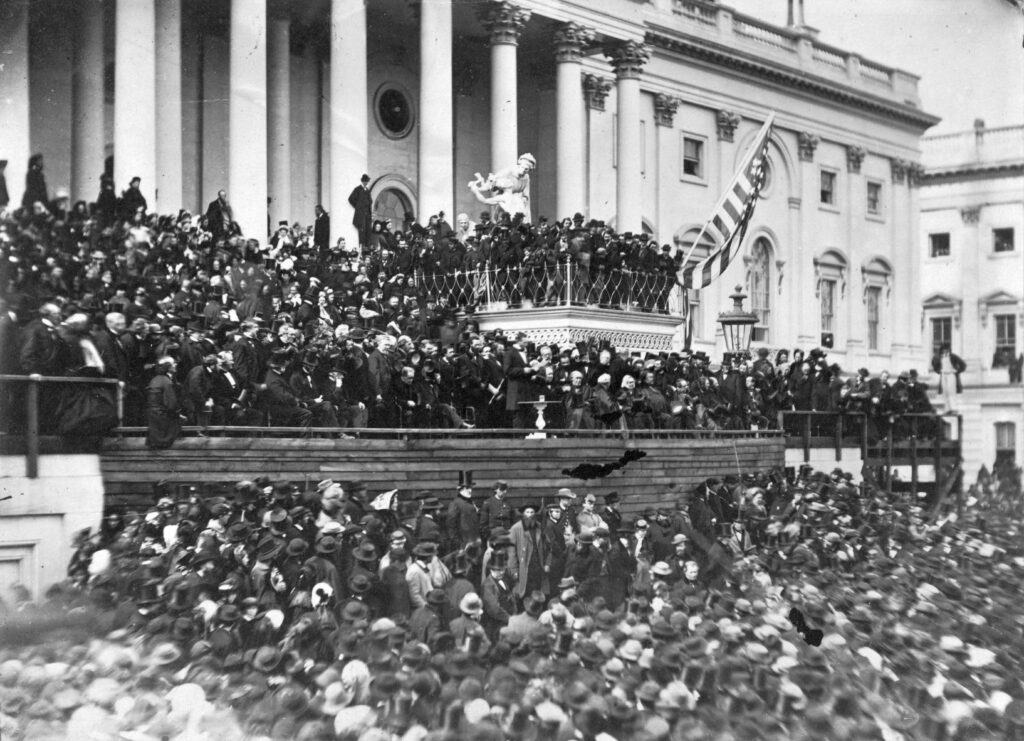
Abraham Lincoln delivering his second inaugural address as President of the United States, Washington, D.C.
The Boston Massacre
On March 5, 1770, shots were heard in Boston, Massachusetts, which stirred a revolution.
The Seven Years’ War with France had left Britain with enormous debt. To recover costs, Parliament passed the Stamp Act in 1765 and the Townshend Acts in 1767, to impose duties on imported goods such as tea, glass, paper, and paint. Colonists, especially in Boston, protested under the slogan “no taxation without representation,” viewing these measures as violations of their rights as Englishmen. Riots and attacks on customs officials followed, prompting the British to station troops in Boston in 1768 to enforce order and protect officials. The presence of soldiers—often poorly paid and quartered among hostile civilians—heightened friction, with frequent brawls between the troops and the town.
On the snowy evening of March 5, while a single British sentry, Private Hugh White of the 29th Regiment, guarded the Custom House on King Street, a dispute escalated when White struck a young wigmaker’s apprentice, Edward Garrick, with his musket. The commotion attracted a growing crowd that lobbed White with snowballs, sticks, and insults. Reinforcements arrived—seven more soldiers under Captain Thomas Preston—forming a defensive line. Amid the chaos, the mob pressed closer and pelted the troops. Accounts vary on what started the firing: some claimed a soldier was knocked down, others heard someone shout “fire.” Without a clear order from Preston, the soldiers discharged their muskets into the crowd.
Five colonists died: three instantly, and two later. Six others were wounded. The event shocked Boston. In the aftermath, acting Governor Thomas Hutchinson removed the soldiers from Castle Island to prevent further violence. Captain Preston and eight soldiers faced murder charges. Remarkably, John Adams and Josiah Quincy defended in a late 1770 trial. Preston and six soldiers were acquitted; two were convicted of manslaughter but received reduced sentences.
Patriots like Samuel Adams and Paul Revere seized the incident for propaganda. Revere’s famous engraving, The Bloody Massacre, depicted an orderly pack of men firing on peaceful civilians. Annual commemorations kept the outrage relevant, by portraying British rule as tyrannical. Though small in scale, the Boston Massacre inflamed colonial sentiment, deepened distrust, and helped unite resistance against Britain, culminating in the dramatic events of 1776.
For more information, the Grateful American Book Prize recommends The Boston Massacre: A Family History by Serena Zabin.
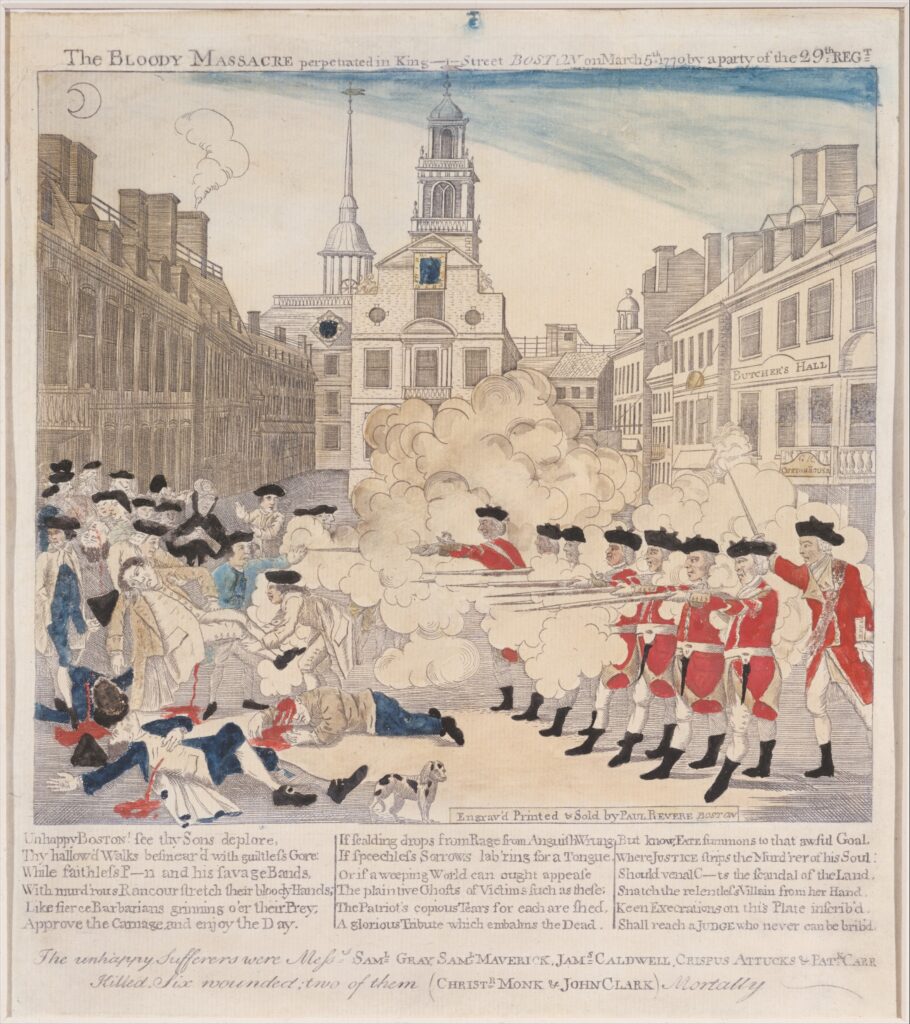
The Boston Massacre by Paul Revere
Michael F. Bishop, a writer and historian, is the former executive director of the International Churchill Society and the Abraham Lincoln Bicentennial Commission.
History Matters is a feature courtesy of the Grateful American Book Prize, an annual award for high quality, 7th to 9th grade-level books dealing with important events and personalities in American history.