War Without Mercy: Liberty or Death in the American Revolution
by Mark Edward Lender and James Kirby Martin
Reviewed by Ed Lengel
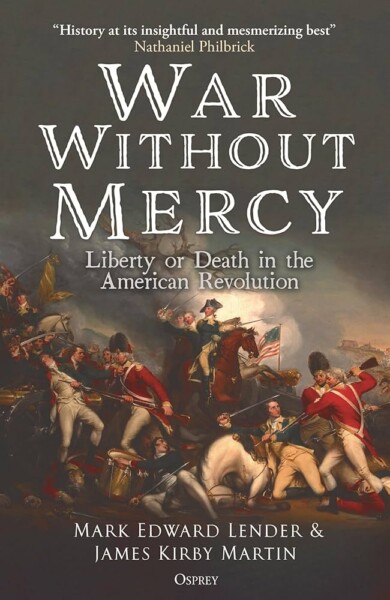
War Without Mercy: Liberty or Death in the American Revolution, by Mark Edward Lender and James Kirby Martin. Osprey, 2025.
The 250th Anniversary of the American Revolution naturally also marks the same anniversary of the Revolutionary War. Beginning with the “Shot Heard Round the World” at Lexington and Concord in April 1775, it continued for eight years until the waning months of 1783. A new nation, declaring its independence in July 1776, emerged at war’s end as the United States of America. The country may truly be said to have been forged in warfare.
Anniversary celebrations have so far—and will certainly continue to be—enjoyable, light-hearted affairs, based on what we have seen with commemorations of Lexington and Concord and, most recently, General Henry Knox’s epic journey from Fort Ticonderoga to Boston with sleds carrying artillery. Reenactments of these events seem like costume parades. Historical interpreters lovingly reconstruct outfits and uniforms; equipment, supplies—and weapons—which explain their purposes to the public to help make history immediate and personal.
In fact, the Revolutionary War—like all wars, really—was a gritty, bloody, cruel affair. Combatants on both sides were—more often than not—irregular fighters, hastily organized militia, and outright civilians in homespun outfits, carrying what munitions they could acquire, using any means they thought necessary to prevail over their adversaries. In War Without Mercy, accomplished Revolutionary War Historians Mark Edward Lender and the late James Kirby Martin have deftly drawn attention to the war’s bleeding underbelly, arguing that it was an “existential” conflict in which patriots, loyalists, Indians, Black Americans, and the many people who drifted between the ideological poles considered their very lives to be at stake much of the time, and discarded eighteenth-century norms of civilized warfare, so-called jus in bello, in the pursuit of victory.
Six chapters in this brief work examine the concept of jus in bello as portrayed in a number of contemporary books; the war in New Jersey; the war in the west, or what we’d now call the Midwest; the War on the New York Frontier; Benedict Arnold’s 1781 raid on New London, and the war in the South. Lender and Martin argued that the Revolutionary War was far more violent than generally recognized, with disproportionate impacts not just on combatants, but on civilians, too. Outright cruelty was widespread, and norms of organized warfare were often recognized only in the breach. Such was the nature of what they repeatedly describe as an “existential” conflict. For this, the authors cautiously ascribe primary blame to the patriots, for initially casting the war as a struggle of pure good against absolute evil, and employing, from the outset, extreme means to defeat their enemies and achieve independence.
Lender and Martin make an important, and valid point. The war was more violent than generally recognized, with a far greater personal, societal, and economic impact than sanitized reenactments can hope to portray. Unfortunately, War Without Mercy contains a number of weaknesses and blind spots that reduce it more to a tentative exploration begging for further research than a definitive study in its own right.
To begin with, War Without Mercy is anecdotal rather than analytical, and largely based on secondary source research. In each chapter, except one, the authors recite cherry-picked instances of violence in each theater of war, and then make broad surmises—guesses, really—about the extent and level of violence across the country. The exception is chapter five, an outlier from the rest of the book, in which the authors argue persuasively—but contradictorily to their general theme—that Benedict Arnold’s September 1781 raid on New London, Connecticut, did not violate jus in bello as it was understood at the time.
Though well-written, the book’s narrative is largely academic and didactic in nature. Thus the authors spend a great deal of time analyzing Emer de Vattel’s 1758 book The Law of Nations and then use it as a manual to determine how the Revolutionary War’s combatants did—or more usually did not—follow its dictates on civilized warfare. Yet in fact most Americans, including even intellectuals and military leaders like George Washington, were probably only vaguely aware of Vettel’s book. For their part, the vast majority of Continental and militia foot soldiers and officers had never heard of Vattel; most of them were illiterate anyway (something Lender and Martin overlook). It should come as no surprise, then, that average combatants followed vague social and religious norms, and their own instincts, in dividing right from wrong.
The lack of comparative context across time and place ultimately undermines War Without Mercy. In one passing reference, the authors compare the American and French wars of revolution and suggest that they were similar in nature. Comparisons are also made between the Revolutionary War and Europe’s Thirty Years War 1618-1648. In fact, there is very little correlation to be made between, for example, the Revolutionary War—even in the South—and the French revolutionary efforts to suppress the rebellious Vendée. Likewise, the Thirty Years War, the Napoleonic Wars (in Spain and Russia, for example), and the Russian, Chinese, and innumerable other revolutionary conflicts across the globe were infinite orders of magnitude more brutal than the American Revolutionary War. In their anecdotes describing widespread bullying, beatings, land confiscations, and so on across America of 1775-1783, the reader is struck most by the lack of extreme violence that characterized these other conflicts. Ironically, this suggests pointing future scholars to study not so much why the American Revolution was violent, but why it was so nonviolent in relation to other conflicts; not why it was “existential,” but why it was not—when the stakes were so high.
Ed Lengel is an author, a speaker, and a storyteller.