The Egg & I
by Betty MacDonald
Originally published 1945
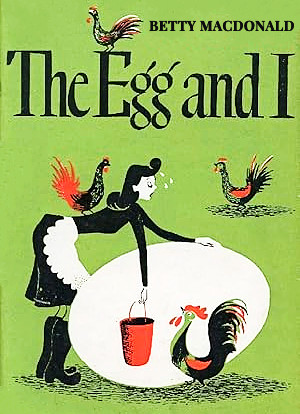
The Egg and I, by Betty MacDonald. Originally published 1945.
Reviewed by Ed Lengel
The immediate post-World War II period was not a carefree, cheerful time in the United States. Far from it, anxiety gripped a generation worried about slipping back into the prewar Great Depression and concerned about how millions of returning service men and women would find jobs and re-integrate into American life. Worse, the United States could no longer retreat into insularity and isolationism. The country had moved onto the world’s stage—for better or for worse–and would have to deal directly with global problems that potentially threatened the very existence of civilization.
Betty MacDonald’s memoir, The Egg and I, was published in the midst of this postwar anxiety on October 3, 1945. Thirty-eight years old at the time of the book’s publication, the author recounted the story—or rather, a series of stories and vignettes—about her experiences as the wife of a young entrepreneur, Robert Heskett (Bob), who Quixotically decided to establish a chicken farm in rural Washington State, in the shadow of the Olympic Mountains. The events described in the book took place during the onset of the Great Depression—from 1927-1931—but that global economic crisis hardly figured in the book. Just fifteen years removed in 1945, those years seemed after World War II to be a lifetime away, almost idyllic by comparison to the uncertain postwar world.
The Egg and I was an instant, albeit unanticipated, phenomenon. MacDonald—by then divorced from Heskett and remarried—promoted the book avidly at appearances across the country, and sales reached an astonishing million copies. The book was marketed as being whimsical and carefree, replete with self-deprecating humor about raising chickens, and zany characters—especially “Ma and Pa Kettle,” slapstick country bumpkins who appear in the book as Betty and Bob’s neighbors. MacDonald, who had never written a book before this one, displayed remarkable writing talent (to the degree that one cannot help suspecting some degree of editorial intervention) and—as her friends and acquaintances confirmed—profound storytelling gifts.
The book’s central promise was fundamentally escapist, and no doubt that’s a large reason while it sold so well at a time when Americans, especially women who were the book’s primary audience, eagerly pursued distraction. Universal-International studios bought the film rights to the book in the spring of 1946, and a year later a movie was released with Fred MacMurray and Claudette Colbert, followed by a series of nine Ma and Pa Kettle films. These were all purely comedic productions and did well with American audiences into the 1950s as the Cold War reached its height (or depths).
It’s ironic, then, to discover on reading The Egg and I that it’s anything but farcical. As MacDonald’s co-worker William Cumming later commented, “Betty’s humor wasn’t kindly, nor homey, nor friendly. It had the malicious edge of a scalpel, and it could cut. Betty saw the flaws of the race as vicious. The fact that these flaws generally ended in hilarious pratfalls didn’t make them any less lethal in her eyes.” The targets of her humor, including the Kettles’ who she claimed were composite characters of people she knew, but apparently were largely based on farmers Albert and Susanna Bishop, were objects not just of fun, but to barely concealed contempt. The same may be said of the Indians MacDonald encountered not just on the chicken farm, but in her early life in Montana. In her book and in person, she made no secret of her revulsion for them.
Less commented-on is the book’s strong feminism. Women, MacDonald states early on, had for generations in her family—and others—came to believe that they must simply adapt themselves to the desires—professional or otherwise—of the men they married. This included meekly accepting their husbands’ desires to enter professions that satisfied their whims, but reduced their families to poverty, and consigned their wives to lives of drudgery. MacDonald believed that she had submitted to such a fate in her first marriage. Though formally complimentary of his persona, and self-deprecatory about her own inability to adapt well to life on the chicken farm, it’s apparent that Bob—whose propensity for inflicting verbal and emotional abuse and disregarding the needs of his wife and children—is not a man she remembered fondly.
Nor did MacDonald hold any affection for the chicken farm. For all the amusing stories she told about it, she hated the place and couldn’t wait to move on. Here too the book reflects a particular perspective on postwar America. The Egg and I was sold as escapist nostalgia. It was not a nostalgia that MacDonald shared. Apparent in every line of her book is a desire to move on from an idealized rural past that was never in fact idyllic and forge a new future from new ideals and ways of living. The Egg and I may and should be enjoyed as humor; but it is also an important social document of a transformational period in the history of the United States.
Ed Lengel is an author, a speaker, and a storyteller.