Robert E. Howard: The Life and Times of a Texas Author
by Willard M. Oliver
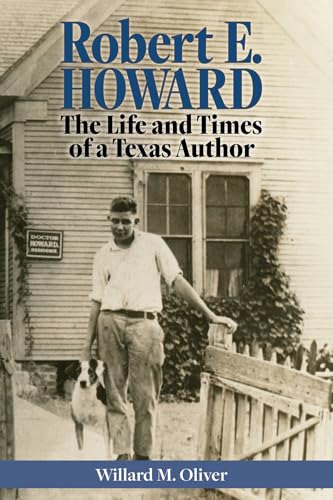
Robert E. Howard: The Life and Times of a Texas Author, by Willard M. Oliver. Denton: University of North Texas Press, 2025
Reviewed by Ed Lengel
Nowhere does the Internet acronym IYKYK, “If You Know, You Know” apply more perfectly than to the world of Robert E. Howard’s fandom. Described clinically, he was one of the leading figures in the wave of pulp literature that started in the United States just after the end of World War I in 1918, and upsurged in the 1920s and 1930s with the widespread publication of thousands of luridly covered popular literature magazines that featured detective, weird, science fiction, and other genres. Among his many admirers, Robert E. Howard—known by them simply as REH—evokes a kind of enthusiastic devotion reserved for very few other authors, even popular modern writers, and members of the established literary canon.
Willard M. Oliver’s Robert E. Howard: The Life and Times of a Texas Author, falls squarely within the realm of fan fiction. One of several biographies of Howard that have appeared since his death by suicide at the age of thirty in 1936, this book explores every conceivable detail of the Howard’s life, including his ancestral antecedents; his parents and relatives; every one of the many small towns in which he lived–even briefly; his playmates and preferred childhood games; and so on—even before it gets to considering his literary output, and his immortal character, Conan the Cimmerian. All that being said, this is a superb biography, not least because it sets Howard squarely in the context of his Texas roots, his family and literary influence, and the madly creative world of pulp literature.
Any modern professional writer– whether fiction or non-fiction–cannot help but be fascinated by the world of pulps. Jack London was among its early pioneers, and it eventually produced masters such as Dashiell Hammett, H.P. Lovecraft, Isaac Asimov, Ray Bradbury, and Robert Heinlein. For every success story, however, there were dozens—even hundreds—of working stiffs, men and women, churning out stories in obscurity, lucky to receive fifty or a hundred dollars per piece, hoping to emerge as an established author in magazines such as Black Mask, Weird Tales, and Amazing Stories and then,—maybe hit the big time.
Howard was one of those toilers. The only child of a chronically ill mother and an often-absent country doctor father, he moved from one small dusty Texas town to another, before his family finally settled in tiny Cross Plains west of Fort Worth. Loath to surrender his freedom to thankless farming or shop work, Howard decided early on that he wanted to become an author. Works about ancient and Dark Age Europe incited his imagination and gave birth to Conan and a bevy of other colorful characters. Oliver shows, however, that Howard’s outlook, good, bad, and everything in between, emerged from his Texas roots. This included not just scenery—Conan’s world looked much like the Texas Hill Country—but human characterization and, above all, violence, and the daily struggle for survival.
A pulp writer’s life during the Great Depression was likewise a struggle for survival. Fabulously imaginative but not antisocial, Howard never managed to make a living on his own, writing day and night on his parents’ live-in porch. He remained firmly within his mother’s orbit; and her death from tuberculosis in 1936 was the immediate cause of his suicide. Howard had many admirers during his lifetime, including fellow pulp authors such as Lovecraft, with whom he carried on an extensive correspondence. Yet despite his popularity with pulp fans, he was never able to do more than eke out an existence from one writing commission to the next. Imagination and the need for money equally fueled his extremely immense output and provided a tremendous gift to his many followers in the ninety years since his death.
Oliver’s absorbing biography must satisfy anyone interested in Howard, his life, and the source of his genius. Even so, it can only hint at the extent of Howard’s influence up to the present day. Conan—as typified in the campy 1982 feature movie starring Arnold Schwarzenegger, has become something of a caricature. More broadly, though, the worlds of imagination spun by Howard have been every bit as influential as those created by acknowledged master J.R.R. Tolkien, doing much to define fantasy and science fiction, gaming, and movies in the twentieth and twenty-first centuries. Gary Gygax, notably, cited Howard as a primary influence in the creation of his still-popular fantasy role-playing game, Dungeons and Dragons.
REH aficionados, then, are not just fans, or literary pedants. They recognize something elemental, deeply satisfying, and inspirational, in Howard’s creation that touches a chord in the ancient, even primeval human need for storytelling. Thanks in part to work like this fine biography, but especially of course to Howard’s own writing, his influence is certain to endure in a changing world.
Ed Lengel is an author, a speaker, and a storyteller.