Katherine Anne Porter
Special to the Newsletter
by Michael F. Bishop
Katherine Anne Porter was an admired American short-story writer, a miniaturist whose polished, ironic prose could compress a great deal into just a few pages. She published only one novel, the bestselling Ship of Fools, but her reputation rests on three slender volumes of stories—Flowering Judas, Pale Horse, Pale Rider, and The Leaning Tower—and later The Collected Stories of Katherine Anne Porter, which won the National Book Award and the Pulitzer Prize.
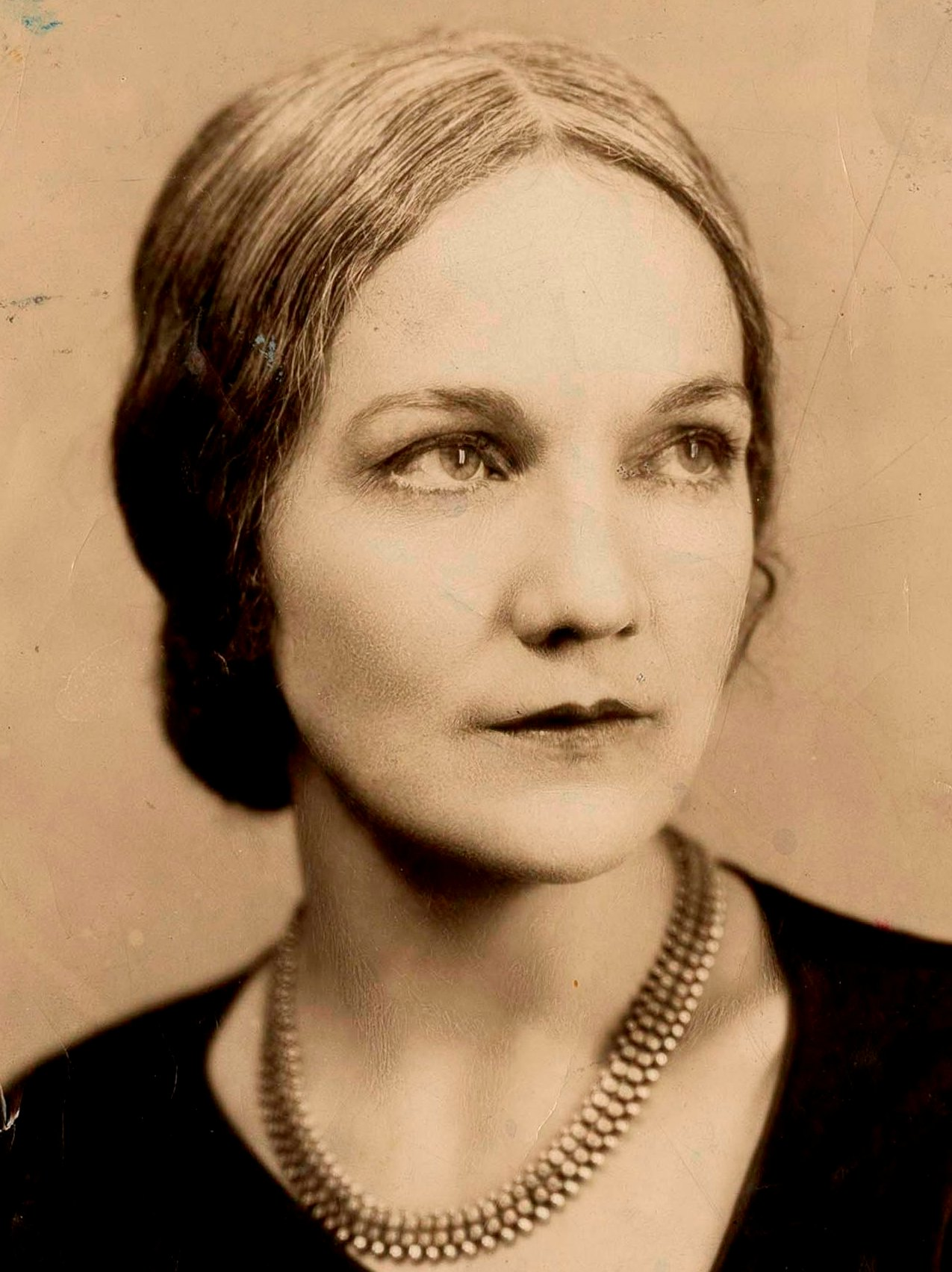
Callie Russell Porter was born on May 15, 1890, in the hardscrabble frontier town of Indian Creek, Texas. She lost her mother at two and was raised largely by a beloved paternal grandmother, Catherine Ann Skaggs Porter, whose death–when Callie was eleven–disabled her last illusion of stability. The family’s slide into poverty left an indelible mark: Porter would later reinvent herself repeatedly—changing her name, her age, her origins—until “Katherine Anne” became the elegant, slightly aristocratic mask which concealed the wounded child inside. She claimed descent from Daniel Boone, attended finishing schools she never completed; and married and divorced at sixteen, the first of several brief–and often violent—unions.
By her mid-twenties she had survived tuberculosis, a near-fatal bout of the 1918 influenza (the basis for the novella Pale Horse, Pale Rider), and a bohemian sojourn in revolutionary Mexico that supplied the material for her earliest masterpieces. Mexico transformed her. Living in Mexico City and Cuernavaca in 1920–21 and again in 1923, she witnessed the aftermath of the revolution, befriended Diego Rivera, and other left-wing artists, and watched utopian dreams curdle into betrayal and bloodshed.
The title story of her first collection, “Flowering Judas,” is set in this world: Laura, an American idealist who smuggles messages for the revolution, finds herself spiritually paralyzed when her revolutionary lover, Braggioni, sings beneath her window. The story’s closing image—the Judas tree blooming blood-red—distills Porter’s recurring theme: the fatal collision of political abstraction with private conscience.
Porter revised obsessively; “Noon Wine,” a thirty-page novella about a Texas farmer who kills a bounty hunter in a moment of confused justice, took her eight years to perfect. Porter spoke of writing as “a kind of torture” and claimed she could not bear to reread her own work after it was published. She warned aspiring writers, “Most people won’t realize that writing is a craft. You have to take your apprenticeship in it like anything else.”
The three novellas in Pale Horse, Pale Rider—Old Mortality, Noon Wine, and the title piece—have often considered her best. Old Mortality dissects the corrosive power of family legend; Miranda, Porter’s frequent alter ego, discovers that the beautiful, doomed Aunt Amy, revered by the clan, was in reality selfish and manipulative. Memory, Porter suggests, is a form of fiction we tell to survive. Pale Horse, Pale Rider was written in the third person but unmistakably autobiographical, captures the hallucinatory terror of the 1918 pandemic: Miranda, a young newspaper woman, hovers between life and death while her soldier lover Adam succumbs to the flu days before the Armistice.
Porter’s politics were complicated. She flirted with socialism in the 1920s, helped raise money for Sacco and Vanzetti, yet grew fiercely anti-communist after Mexico and later supported Joseph McCarthy. She distrusted ideology in any form; her stories are full of characters who embrace causes only to discover the cause has devoured them. Her Catholicism, too, was idiosyncratic—more aesthetic and moral than doctrinal—deepened in old age.
Ship of Fools, twenty years in the writing, was her only full-length novel and a popular triumph, though many critics found it stiff compared to the stories. A moral allegory set aboard a German passenger ship sailing from Veracruz to Bremerhaven in 1931, it portrays a microcosm of pre-Nazi Europe: anti-Semitism, and nationalism, as petty cruelty festered above and below decks.
She never had children and lived much of her life alone, moving restlessly from Connecticut to Washington, DC; Paris to Saratoga Springs. Honors came late—the Pulitzer at seventy-five, election to the American Academy of Arts and Letters—but she accepted them with characteristic hauteur, convinced she had been neglected.
In her final years, half-blind, and frail, she donated her papers to the University of Maryland and quarreled bitterly with biographers who tried to pin down the facts she had spent a lifetime embellishing. Three years after a stroke had immobilized her, Porter died on September 18, 1980, in Silver Spring, Maryland.
Katherine Anne Porter, who put her heart into her work, once said that art is “the only means by which one human being can penetrate to the heart of another.”
Michael F. Bishop, a writer and historian, is the former executive director of the International Churchill Society and the Abraham Lincoln Bicentennial Commission.